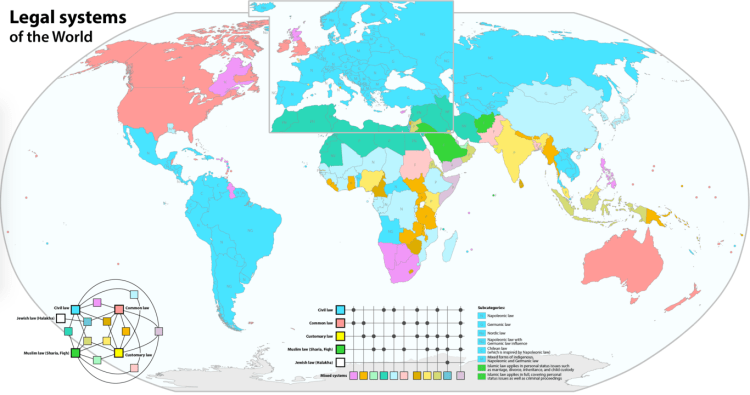
The legal systems of countries around the world can be said to fit generally into three distinctive categories – Civil law, Common law, and Sharia law. Civil law makes up the majority of countries in the world and is derived originally from Roman law and later the Napoleonic code spread by the French empire across Europe. Civil law can be described simply a law structure that is highly codified into a referable system. It leaves little room for interpretation from judges as each law should be referable to a previous statute.
In contrast to Common law, also know as case law or precedent law, is derived from the English legal tradition. Common law puts much more power into the hands of judges and their interpretation of the law over time. These judge-made decisions create precedential authority to prior court decisions which bound the judge’s opinion to pervious court rulings. This legal system was spread by the British Empire to it’s dominions across the globe including: the United States, Canada, Australia, New Zealand, and is a hybrid system in many others.
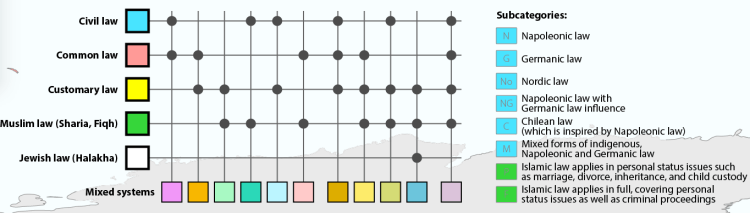
Sharia law or Muslim law is present in muslim majority countries in the Middle East and North Africa. This legal tradition is derived directly from the Quran and was spread during Islamic Caliphate in 750 AD. The remaining parts of the world including most of the countries in Africa, South Asia, and Southeast Asia have some hybrid law system mixed between Civil, Common, Sharia, and Customary law. Refer to legend below for what category your country falls into.



 This representation is a borderless 3-dimensional world population map. The map does a great job of depicting the world’s population concentration zones in East Asia, Europe, North America, etc. What is striking is not only do oceans separate population centers from one another, but large stretches of desolate land – which are essentially operating like waterways – cutting some parts of the world off from others. For example, the Sahara separating North Africa from Sub-Sahara Africa, the Amazon in Brazil, the Himalayas between India and China, and the outback deserts make Australia almost non-existent on the map.
 map_∞
map_∞ 