Russian Military Bases Aboard

POST_Russian military bases.png

Overseas military bases enable a country to conduct expeditionary warfare and maintain order in their respective areas of control. The vast majority of countries in the world are not powerful enough to exhibit influence outside their defined boarders – they have a difficult enough time maintaining order within ‘their’ country as is. In fact, there are only 9 countries that have a military base located outside their own territory. Further, most of these countries only have influence (bases) around countries that boarder them and are not much of a global force.

The map above displays the location of Russian military bases aboard. All of these are located in former USSR and other past communist allies. Russia has 9 bases located in another country’s territory, fourth most by a country in the world. Below is a list of the 9 countries that have bases located in other nation’s territory (note – this is not the number of total bases, but the number of countries that listed country has bases located in):

Japan – 1, China – 1, India – 2, Turkey – 4, Italy -5, Russia – 9, UK – 13, France – 14, USA – 63

Another way to look at this is:

All other countries combined – 47, USA – 63
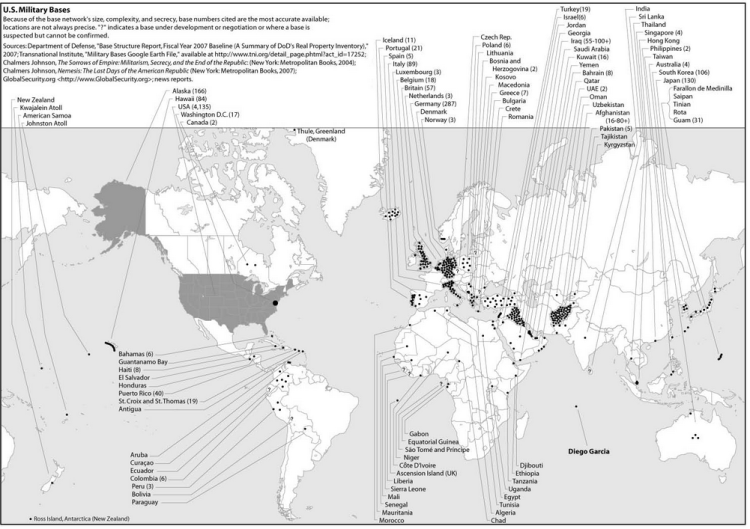
 

US Military Bases Aboard

US military bases 2.png

The US military has over 255,000 actively deployed personnel in 156 countries and currently has over 800 bases on 63 countries worldwide. The underlying land surface area of these bases is estimated at 30 million acres (46,875 sq mi) – roughly equal in area to the country of Greece (which itself has 7 US military bases on its territory). With so many countries with active US military bases on them – it begs the question if these countries are truly sovereign nations at all.

World Legal Systems

World Legal systems.png

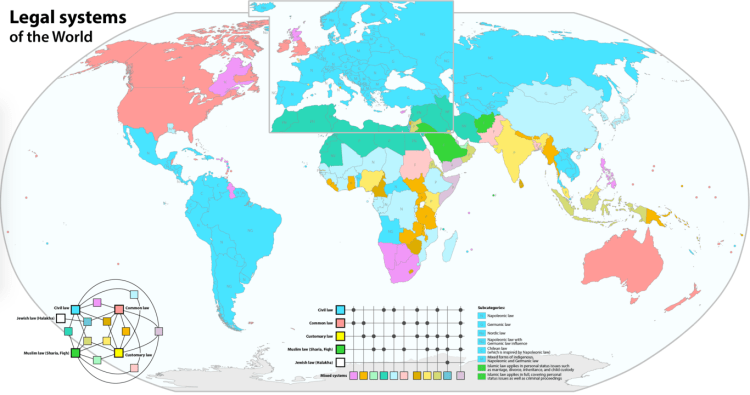
The legal systems of countries around the world can be said to fit generally into three distinctive categories – Civil law, Common law, and Sharia law. Civil law makes up the majority of countries in the world and is derived originally from Roman law and later the Napoleonic code spread by the French empire across Europe. Civil law can be described simply a law structure that is highly codified into a referable system. It leaves little room for interpretation from judges as each law should be referable to a previous statute.

In contrast to Common law, also know as case law or precedent law, is derived from the English legal tradition. Common law puts much more power into the hands of judges and their interpretation of the law over time.  These judge-made decisions create precedential authority to prior court decisions which bound the judge’s opinion to pervious court rulings. This legal system was spread by the British Empire to it’s dominions across the globe including: the United States, Canada, Australia, New Zealand, and is a hybrid system in many others.

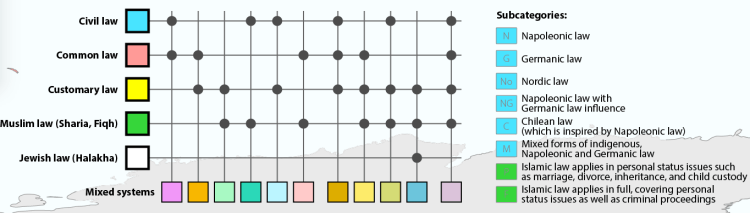
Sharia law or Muslim law is present in muslim majority countries in the Middle East and North Africa. This legal tradition is derived directly from the Quran and was spread during Islamic Caliphate in 750 AD. The remaining parts of the world including most of the countries in Africa, South Asia, and Southeast Asia have some hybrid law system mixed between Civil, Common, Sharia, and Customary law. Refer to legend below for what category your country falls into.

Legal systems legend.png

Country Executions

The United States is the only country in the western world to still retain the death penalty. It is also with the minority of the world – just 58 of 198 countries (29%) have used the death penalty in the last 10 years.

The chart below displays the top 25 countries ranked by executions over the past decade. China and Iran ‘lead’ in this category by a large margin. Iran has the distinction of having highest number of execution per capita. Meanwhile in China, the number of executions is officially unknown and regarded as a “state secret” – Estimates range from as high as 2500 to 5000 per year, more than the rest of the world combined!

The United States does not fair very well either – 5th in the world in executions with 350 since 2007.

POST_Executions by country.png

United Nations Veto Power

Screen Shot 2012-10-04 at 10.04.31 AM.png

A criticism of the United Nations Security Council is the veto power of the five permanent nations – China, France, United Kingdom, United States, and Russia. A veto from any one of these nations can halt any possible action the Council could take. This veto may cripple any UN armed or diplomatic response to a crisis somewhere in the world.

Above is bar chart displaying the number of vetoes by the five permeant members of the UN Security Council. Typically in the western media it is presented that, time and time again, if it where not for vetoes from China or Russia the West could have intervened and prevented some conflict. Yet, a look at history presents a counter narrative.

Early in the history of the UN, the USSR used it’s veto power frequently. From 1945 to 1966 the USSR had a total of 105 vetoes compared to 6 for the four other members combined! However, over the next decades the situation reversed itself.

From 1986 to 2007, the United States took a dominate position using it’s veto power 36 times compared to 18 for the remaining four members. Combining the UK and France with the US (the UK and France voted in combination with the US on all of their vetoes) the total is: Western nations – 47, Others – 7. Further, John J. Mearsheimer is quoted that “since 1982, the US has vetoed 32 Security Council resolutions critical of Israel, more than the total number of vetoes cast by all the other Security Council members.”

POST_UN veto 1986-2007.png

To be fair, since 2007 there has been a large uptick in vetoes cast by Russia and China – virtually all them concerning the situation in Syria and the Ukraine. The total vetoes from 2007 to present are: Russia – 9, China – 5, France, UK, US combined – 1. Further, China voted with Russia on all 5 of it’s vetoes.


State Politics

POST_Screen Shot 2012-10-11 at 12.00.51 AM.png

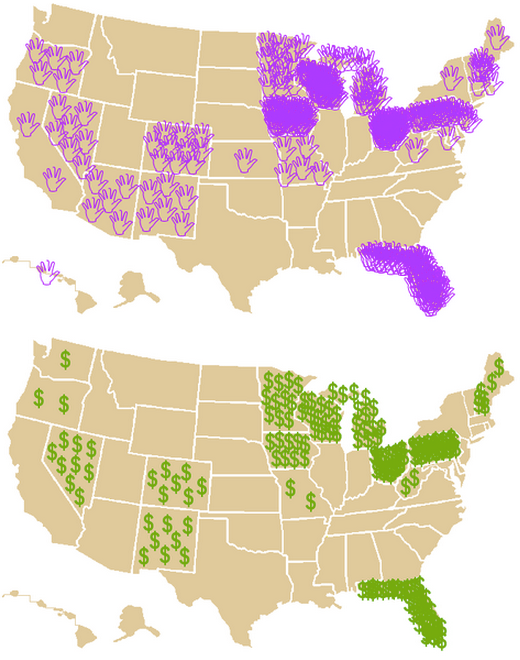
The above graphic displays the number of visits by presidential candidates (hand waves) and the amount of money spent (dollars signs) per state during the 2004 election. What is quickly apparent is only a few states are (politically speaking) “important” – these states being the so-called “swing states”.

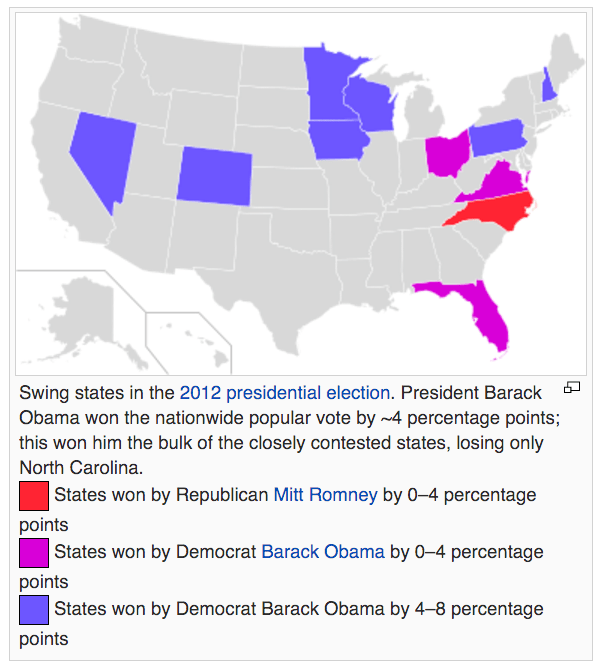
The map below shows what states were within in +/- 4% margin of victory between the two opposing parties during the 2012 campaign – namely: Ohio, Florida, North Carolina, and Virginia. Florida and Ohio are particularly important as they are both swing states and have large population. Florida has 27 electoral college votes (third most in the US) and Ohio has 20 (seven most). The relative importance of these states and other “swing states” are highlighted above in the amount money and visits by political candidates. Do you still think your vote counts?

Screen Shot 2016-03-06 at 9.15.03 PM.png