US And Europe Size

US, Europe size.png

The map above projects western and central Europe on top of a map of the United States. The European Union has 510 million people people living within a territory of 4,324,782 square km. Compare that to the Unites States with a population of 324 million people living within 9,883,517 square km of territory – the US is more than twice as big as the EU in area with only 2/3 its population.

What can be inferred from the numbers above is the population density between two areas. The EU has a population density of 304 people per square mile (almost as much as China at 370). Compare that the US with a population density of only 85 people per square mile! The world average population density is 140 people per square mile – if the US increases in population enough meet the world average, it’s population would increase to 530 million people. If the US ever become as densely populated as Europe, its population will swell to over 1.1 billion people – almost as much as present day China!

House Prices and Tech

POST_TechHousing.png

The bar chart on the left displays the number of technology related jobs per 1000 jobs for select cities. The bar chart on the right displays the median house price for the same cities on the left. What jumps out from this comparison is how expensive house prices are in the Bay Area compared with other tech centers around the country. Despite having roughly the same number of tech related jobs (7.9% and 7.6%) home prices in San Francisco are more than two and a half times more expensive than homes in Seattle (1.2 million compared with 430k). Another finding is that even if cities have a higher fraction of their laborforce working in tech jobs, most cities in this sample do not have home prices far above the US Average.

Tech Company Age

Facebook, LinkedIn, and Salesforce are tech companies with the youngest median employees age, each below 30 years old. Compare that to older tech companies (both in terms of company age and employee age) such as IBM, Oracle, and HP – each with median employee ages older than 37 years.

POST_TechAge.png

Tech Job Locations

POST_TechJobs.png

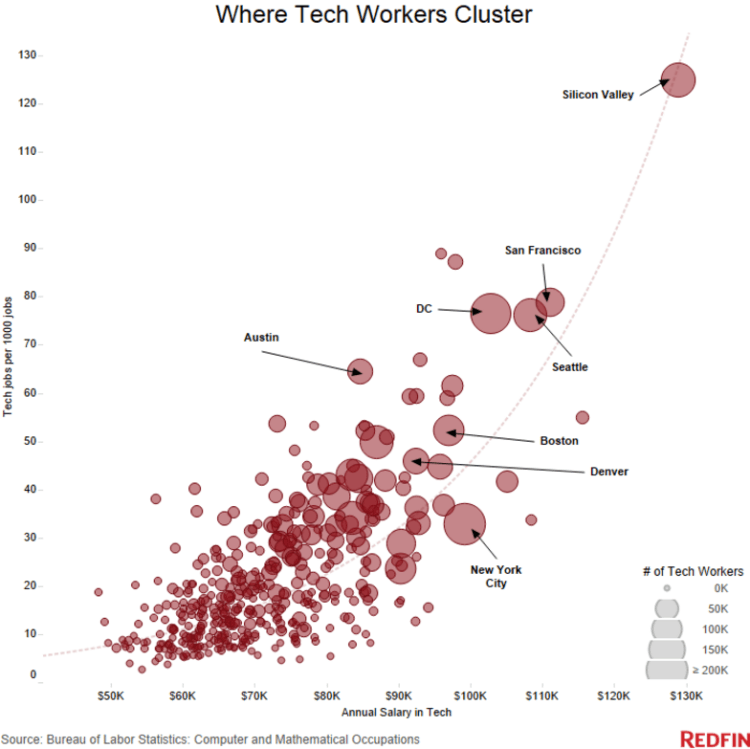
There are approximately 4 million technology related jobs located in the United States – that number translates to about 2% of the US labor force working in tech. How does that 2% figure compare with tech concentrated cities around the country? The graphic above displays the number of tech jobs per 1000 jobs compared with the annual salary of tech workers. What’s striking at first glance is that not only do tech workers make higher incomes the more tech jobs are concentrated, but they make exponentially higher incomes. This finding seems to indicate that tech workers skill sets compliment each other leading to an exponential increase in each worker’s productivity.

Not surprisingly, Silicon Valley tops the list (by a large margin) in the number of tech jobs per capita by city (or region in this case). Silicon Valley has approximately 13% of it’s workforce working in tech – almost 7 times the US average of just 2%. Further, the next closest city to this figure is San Francisco at 8%, literally the next closest city to Silicon Valley by proximity. SV and SF also lead in annual salaries for tech workers in large cities following the model’s prediction above. Other leading tech concentrations are: Washington D.C. with 7.8% of it’s workforce in tech, Seattle 7.6%, Austin 6.4%, Boston 5.2%, and Denver 4.6%

Anatomy of Mass Shootings

POST_Mass shootings.png

If you are involved in a mass shooting (defined as gun related death of four or more people) the event will most likely have the following statistics: It will take place at your workplace (49%), will be from a white (59%) male (96%) that will have prior signs of mental illness (45%) and the weapon will have been obtained legally (79%) of the time.

Gun Policy and the US Congress

Screen Shot 2016-07-11 at 1.12.07 PM.png

Gun Control is a polarizing issue between the two major parties in the United States. Of representatives currently serving in congress (the 114th) the split is clear – 93% of Republicans support gun rights, while 97% of Democrats support more gun control. With virtually no overlap between the parties, it seems the only way to change existing gun policy is for one party to have a clear majority across each level of government – the House of Representatives, the Senate, and the President.

Gun Deaths by Country

Gun deaths.png

With proposed gun regulations in the news in the US, its insightful to ask –  how does the United States compare with other developed countries in gun violence? Above is a graphic displaying the number of gun related deaths per 100k population for all 34 countries in the OECD (Organization for Economic Cooperation and Development), a group of the most developed nations in the world.

There is one clear outlier – the US has 2 to 3 times the number of gun related deaths per capita than all other comparable countries. Although the number gun related deaths have gone down drastically since the 1980’s, the United States still has twice the number of deaths per capita than the next highest OCED country. Numbers like these seem to indicate that more guns in a society lead to more gun related deaths – not less – as some pro-gun advocates remark.

US Bombed Countries (Post 1945)

POST_Countries US has bombed since 1945.png

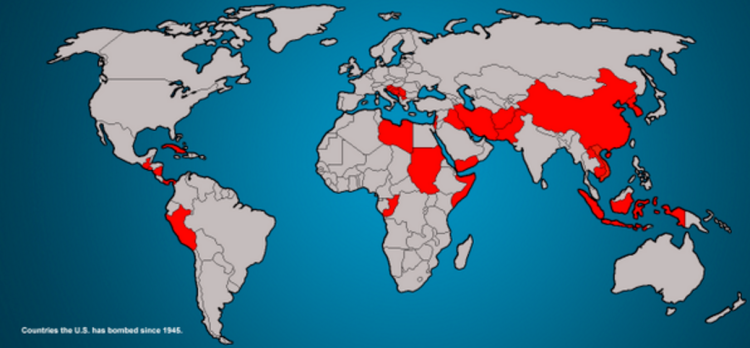
Above is a map of countries the United States has bombed since the end of WWII. A small portion of China was bombed by the US during the Korean War when the US government did not recognize the “People’s Republic of China” as the legitimate government of mainland China. (that lasted up until the mid-1970’s).

Here is a complete list of countries bombed by the United States:

Korea and China 1950-53 (Korean War), Guatemala 1954, Indonesia 1958, Cuba 1959-1961, Guatemala 1960, Congo 1964, Dominican Republic 1965-66, Peru 1965, Laos 1964-73, Vietnam 1961-1973, Cambodia 1969-70, Guatemala 1967-1970, Grenada 1893, Lebanon 1983-84, Libya 1986, El Salvador 1980’s, Nicaragua 1980’s, Iran 1987, Panama 1989, Iraq 1991 (Gulf War), Kuwait 1991, Somalia 1993, Bosnia 1994-95, Sudan 1998, Afghanistan 1998, Yugoslavia 1999, Yemen 2002, Iraq 1991-2003 (US and UK regular bombings), Iraq 2003-present, Afghanistan 2001-present, Pakistan 2007-present, Somalia 2007-08, 2011, Yemen 2009, 2011, Libya 2011

US State Population Growth

US state pop growth.png

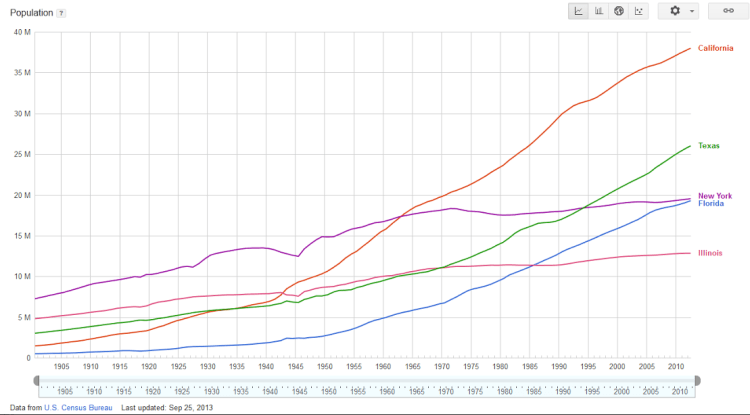
Above is a graph displaying the five most populous states in the United States from 1900 to 2013. These states – California, Texas, New York, Florida, and Illinois – combine for 119 million people, 37% of US total population.

What’s striking from the graph above is the growth behavior from California, Texas, and Florida compared to New York and Illinois – the latter leveling off and the former having exponential growth. California and New York had the same population in the mid 1950’s, now California is twice as populous as New York.

State population projects are displayed in the table below. California is expected in grow to 44 million people by 2030, Texas to 31 million, and New York to 22 million.

Screen Shot 2016-06-12 at 9.02.42 PM.png