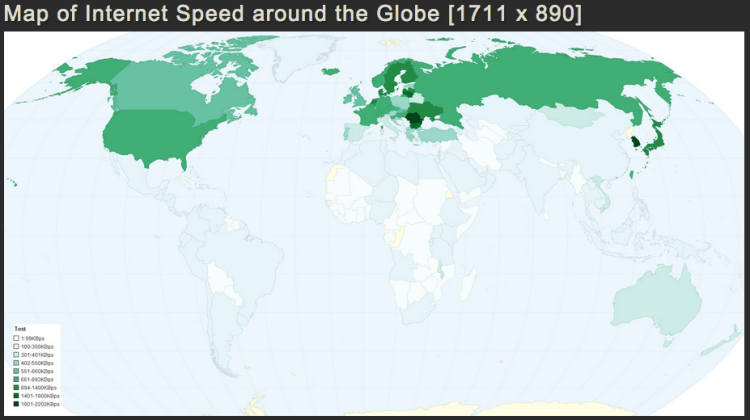
As more of the economy and economic growth is intertwined with the internet – speed and connectivity are highly important to the success of countries in the 21st century. As displayed above, there is large disparities in internet access and connectivity speeds between countries in the developed world and in undeveloped areas.
In the 2015 Q3 ranking by Akamai, the top ten countries by average connection speed (in Mb/s) were: (1) South Korea 20.5, (2) Sweden 17.4, (3) Norway 16.4, (4) Switzerland 16.2, (5) Hong Kong 15.8, (6) Netherlands 15.6, (7) Japan 15.0, (8) Finland 14.8, (9) Latvia 14.5, and (10) Czech Republic 14.5.
In comparison to other developing countries in the world: Mexico ranks 68th at 5.5 Mb/s, China 91st at 3.7 MB/s, Brazil 93rd at 3.6 Mb/s, and India 116th at 2.5 Mb/s.
The United States is ranked 16th in the world by average connection speed at 12.6 Mb/s, slightly above average in the developed world. Although, the numbers are skewed in favor of small density connected countries without rural areas to bring the average down. The US average may be slower than some small dense northern European countries, but when compared the the European Union as a whole, the US is much faster – 12.6 Mb/s to 8.1 Mb/s.
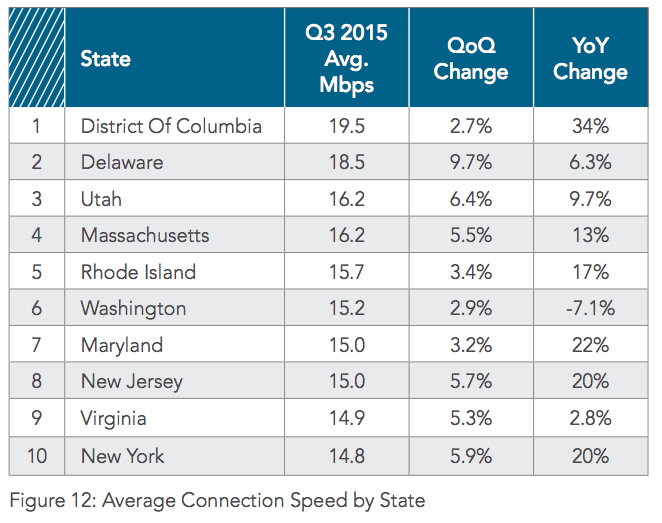
If the US states where ranked individually, Washington D.C. would rank 2nd in the world in average internet connection speed, Delaware 3rd, Utah 6th, Massachusetts 7th, and Rhode Island 10th. As of 2014, the US state with the slowest average internet speed was Alaska at 7 Mb/s.

 map_∞
map_∞ 