US City Commute Patterns 2008

Screen Shot 2017-09-04 at 10.47.14 PM.png

Above is a graph displaying the percentage of people that commute by public transit on the x-axis and the percentage commuting by car on the y-axis for various cities around the United States. The size of the bubble relates the workforce population of each city. There doesn’t appear to be a relationship between the size of the city’s population and the percentage of those taking public transit, but if one looks at city density a relationship is clear. Of the top 20 cities in the US by population, the highest density in order are: New York City, San Francisco, Boston, Chicago, Miami, Philadephia, and Washington DC. With exception of Miami (commute data not listed), all of top 6 highest density cities also have the highest fraction of their workforce commuting by public transit.
United States Population Map

Screen Shot 2017-07-31 at 2.52.32 PM.png

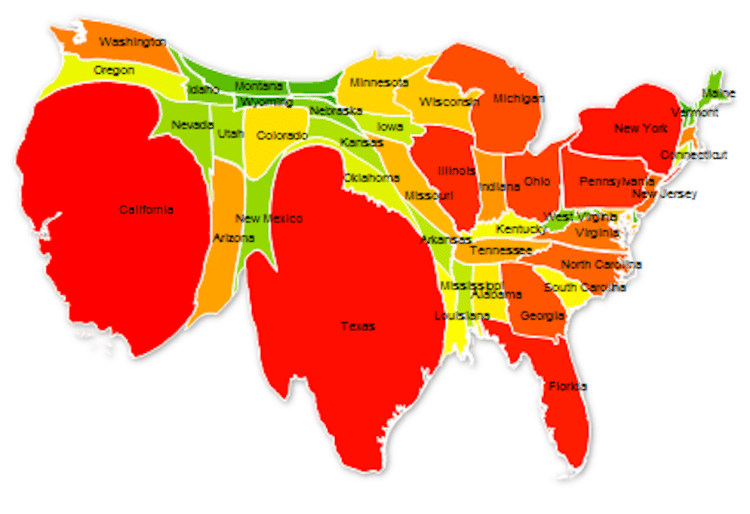
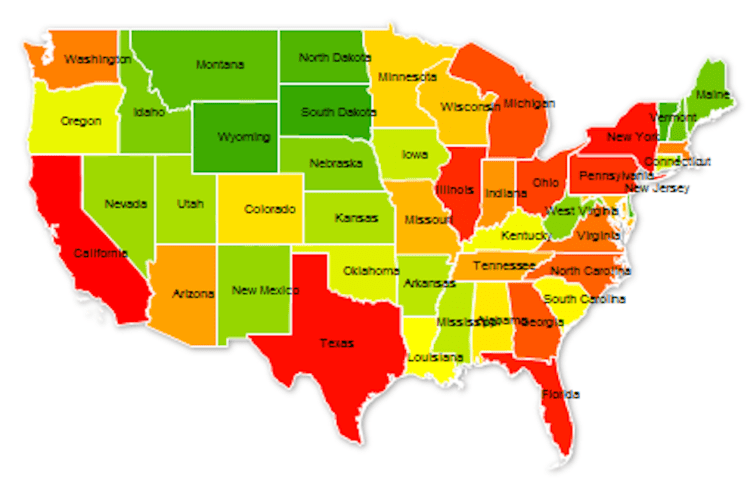
As of 2017, the United States population stands at 324 million – the third largest country in the world by population behind India and China. The population ranges across the nation from state to state, from a high of 39 million in California to a low of 585 thousand in Wyoming. The map above distorts each state’s normal area to display its relative population size. In order words, California population represents 12% of the US total and thus takes up 12% of the map, Texas 8.6%, Florida 6.3%, and so on until Wyoming with 0.18%. The states are color coded by groups of ten with the largest ten in red, the next ten in orange, then yellow, light green, and dark green. California and Texas represent 1/5th of US population and the top 5 states make up 37%. The map below is of the United States as normally displayed, with each state relative to it area.

Screen Shot 2017-07-31 at 2.52.36 PM.png

United States Climate Alliance

Screen Shot 2017-07-24 at 9.47.15 PM.png

Even though President Trump withdrew the United States Federal Government from the Paris Agreement on Climate Change, it doesn’t prevent US States or cities from continuing to uphold the agreement. So far, 13 states have committed to Paris Agreement and ~300 cities (including the all of the top 10 largest cities: NYC, LA, Chicago, Houston, Phoenix, Philadelphia, San Antonio, San Diego, Dallas, and San Jose). The map above displays the US states that are currently still in the Paris agreement in blue and the states considering joining the group in green. This group (in blue) made up 32.3% of the US population and 37.6% of US GDP in 2016. Roughly speaking, it can be said that 1/3 of the United States is still part of the Paris Agreement on Climate Change. The map below displays the cities in the agreement (in red) and the USCA in green (as of June 1).

Screen Shot 2017-07-24 at 9.50.03 PM.png

Europe Income Brackets

POST_Europe GDPpc.png

Above is a map of Europe color-coded into three income brackets – Dark green: greater than 40k euros per capita, Light green: between 20k and 40k euros per capita, and red: less than 20k euros per capita. Note the values are calculated in Purchasing Power Standards (PPS) a metric used by Eurostat for cross-country comparisons. PPS tires to correct for cost of living and price level differences, especially among nations with different currencies. For comparison to the United States, 40k euros converts to 44k dollars (2017 prices). US GDP per capita is 55k dollars, with the highest continental state: New York at 72k USD and lowest: Mississippi at 35k USD. This means the area’s in dark green in the map above (among the highest in Europe) would rank on the lower end of US states, around 40th out of 50.

China’s Population Density

Screen Shot 2017-04-12 at 9.37.57 AM.png

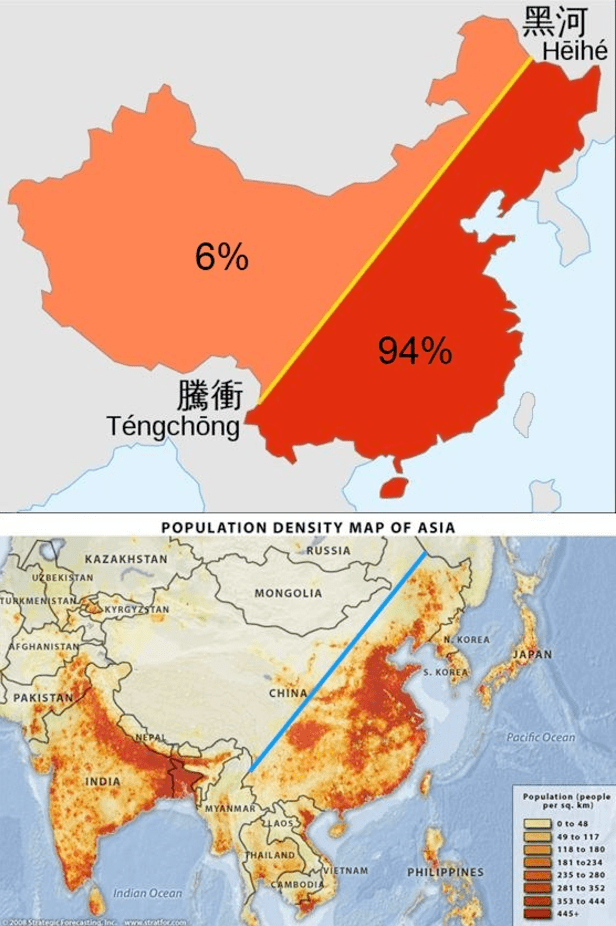
Only about 30 percent of China’s landmass is habitable with approximately 40% of it’s land covered by mountains (in the southwest) and an additional 25% deserts (in the northwest). The maps above display that 94% of China’s population lives on the eastern side of it’s territory. The map below displays the location of China’s deserts and arid regions.

China and India make of 40% of the world’s population and although this figure seems strikingly high, estimates from 1 AD indicate the China and India combined for 60% percent of world population back then! Anyone who has visited either country is aware that both have very high population density. For comparison, world population density is 140 people per square mile – India is about 10 times that with 1008 people per square mile (ppsm) and China is 370 ppsm. Given what we know about the geography of China, this density estimate is quite low and once discounting it’s uninhabitable land, China’s density is more around 1233 ppsm. (Given that about 25% of India’s land is uninhabitable, a more direct comparison would put India density at 1344 ppsm). For those interested, here is the population density for some other countries: European Union (UK included) 304 ppsm, United States 85 ppsm, Brazil 62 ppsm, Russia 21 ppsm, and Canada 9 ppsm.

Screen Shot 2017-04-14 at 2.59.30 PM.png

Expansion of Russia

Screen Shot 2017-03-20 at 12.45.13 PM.png

Russia is the world’s largest country in area with nearly 11% of the world’s landmass. This area is approximately the size of the United States and Canada combined! It is a transcontinental country with territory extending into Europe and Asia. In fact, its Asian land portion alone makes it the largest country in Asia and its European land portion alone makes it the largest country in Europe! Above is a map displaying the expansion of Russian territory from 1613 to 1914. Despite all this growth in territory over the years, approximately 80% of Russia’s population still lives in the Green or Yellow portions on the map above (territory Russia controlled dating back to 1613).

Cousin Marriage

POST_Cousin marriage.png

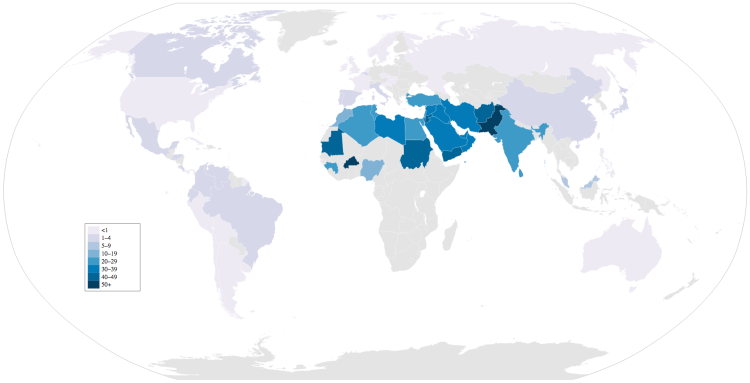
This may seem shocking, but worldwide approximately 10% of all marriages take place between first or second cousins. Above is a map displaying the relative percentages for marriages between first or second cousins for each country (Note: countries in gray mean there is not data). Marriages between cousins are concentrated in the middle east where some countries have as high as 50% of marriages between first or second cousins! The middle east region averages about 1/3 of all marriages to cousins – three times the world average.

Island Nations

Screen Shot 2017-03-04 at 3.39.11 PM.png

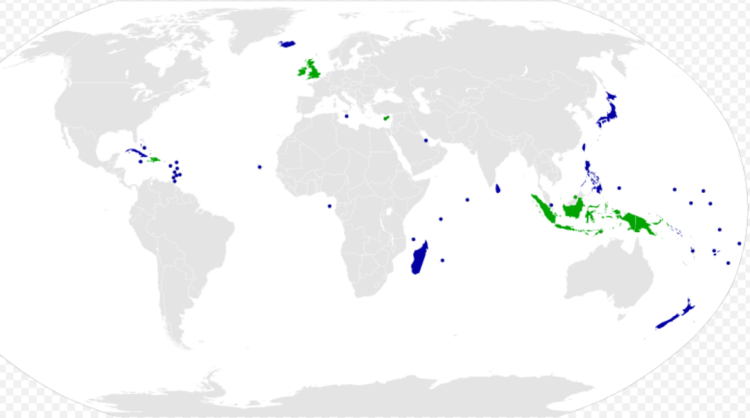
Of the 193 UN member nations, 46 are island nations. This means that nearly a quarter of the world’s sovereign countries are islands. The largest island nations by population are Indonesia (260 million), Japan (126 m), Philippines (102 m), and the United Kindom (65 m). Of the 46 island nations, 13 are in the Caribbean, 13 are in Oceania, 10 are off the coast of Asia, 6 are off the coast of Africa, and 4 are off the coast of Europe.

For those wondering why Australia is not considered an island due to its status as the world’s smallest continent – The size comparison below shows the world’s largest island by area (Greenland) next to Australia. Australia is 3.5 times larger than Greenland!

Screen Shot 2017-03-04 at 3.49.11 PM.png

Netflix Subscription Growth

Screen Shot 2017-01-22 at 8.30.49 PM.png

The subscription growth of Netflix over the past 5 has been stunning, especially when you consider the performance of its competitor: cable. As of the fourth quarter in 2016, Netflix now has more subscribers than total cable subscribers – growing from under 25 million in 2012 to nearly 50 million by 2016. Note that these figures only include US domestic subscribers, not global users. Global subscribers are expected to rise as Netflix expanded into new markets in Africa, Asia, and Eastern Europe (pictured in the graphic below). It seems that people are not watching less TV, rather watching it through a different and more mobile friendly medium.

Netflix and the world.png