Cousin Marriage

POST_Cousin marriage.png

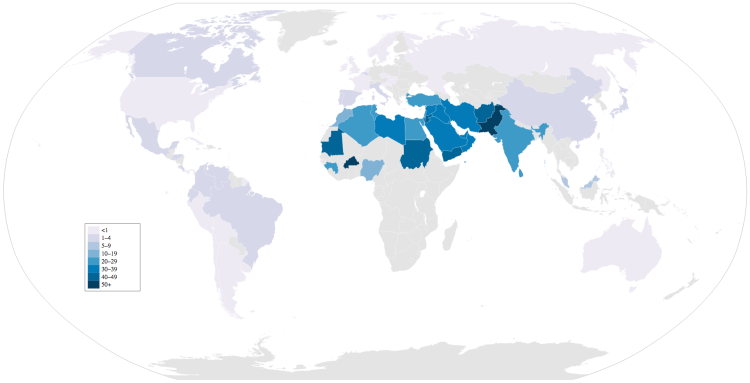
This may seem shocking, but worldwide approximately 10% of all marriages take place between first or second cousins. Above is a map displaying the relative percentages for marriages between first or second cousins for each country (Note: countries in gray mean there is not data). Marriages between cousins are concentrated in the middle east where some countries have as high as 50% of marriages between first or second cousins! The middle east region averages about 1/3 of all marriages to cousins – three times the world average.

The Digital Age

Analog Digital Storage.png

According to this map, the ‘digital age’ began in 2002 when digital storage overtook analog storage in market share. From 2002 to 2007, digital storage share grew from 50% to 94%! Today, that figure is well over 99%.

Island Nations

Screen Shot 2017-03-04 at 3.39.11 PM.png

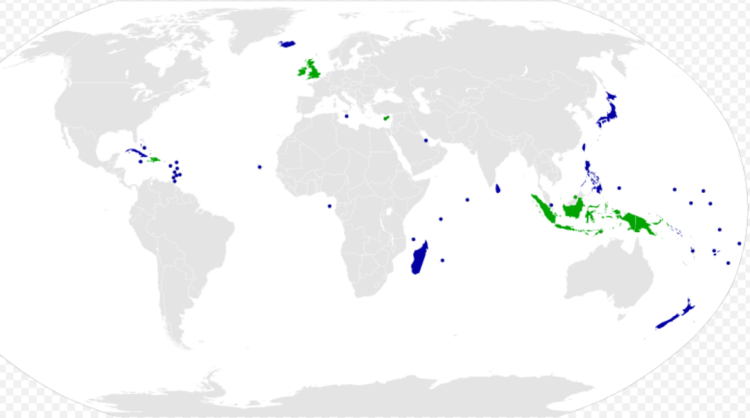
Of the 193 UN member nations, 46 are island nations. This means that nearly a quarter of the world’s sovereign countries are islands. The largest island nations by population are Indonesia (260 million), Japan (126 m), Philippines (102 m), and the United Kindom (65 m). Of the 46 island nations, 13 are in the Caribbean, 13 are in Oceania, 10 are off the coast of Asia, 6 are off the coast of Africa, and 4 are off the coast of Europe.

For those wondering why Australia is not considered an island due to its status as the world’s smallest continent – The size comparison below shows the world’s largest island by area (Greenland) next to Australia. Australia is 3.5 times larger than Greenland!

Screen Shot 2017-03-04 at 3.49.11 PM.png

Netflix Subscription Growth

Screen Shot 2017-01-22 at 8.30.49 PM.png

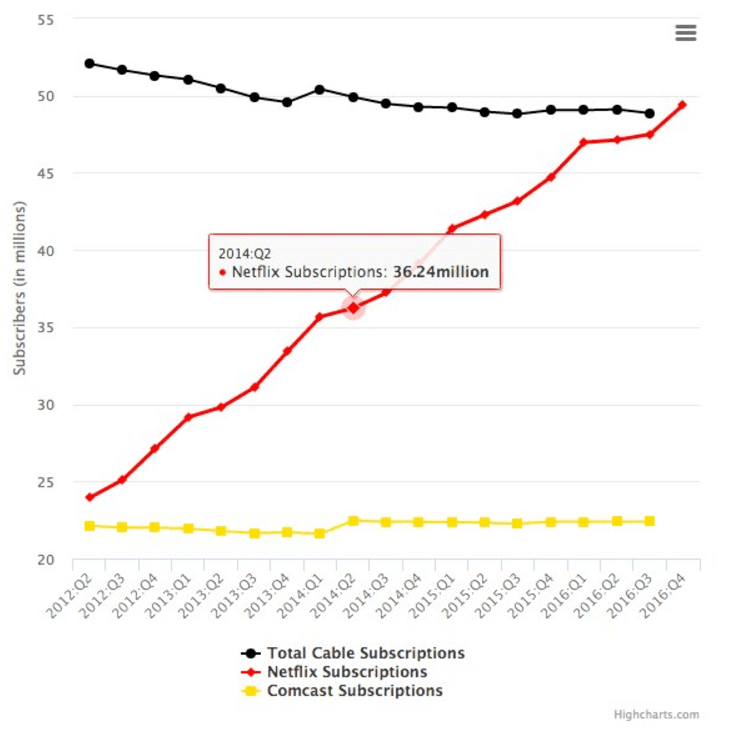
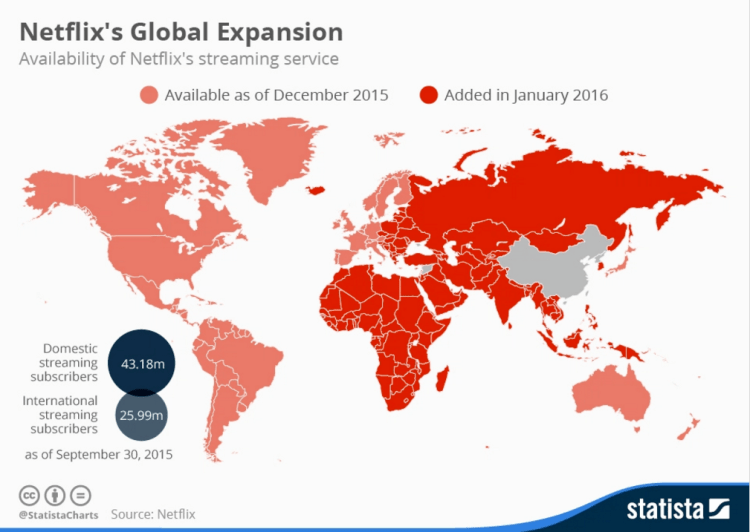
The subscription growth of Netflix over the past 5 has been stunning, especially when you consider the performance of its competitor: cable. As of the fourth quarter in 2016, Netflix now has more subscribers than total cable subscribers – growing from under 25 million in 2012 to nearly 50 million by 2016. Note that these figures only include US domestic subscribers, not global users. Global subscribers are expected to rise as Netflix expanded into new markets in Africa, Asia, and Eastern Europe (pictured in the graphic below). It seems that people are not watching less TV, rather watching it through a different and more mobile friendly medium.

Netflix and the world.png

Historic Economic Power

Screen Shot 2017-02-18 at 2.04.02 PM.png

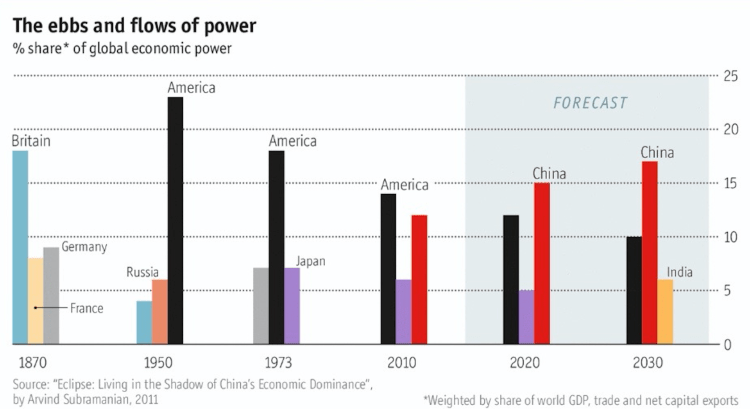
The chart above shows the percent of global economic power (defined as the weighted share of world GDP, trade, and net capital exports) for the top three countries in selected years ranging from 1870 to (projected) 2030. To me, the graph shows the decline in power of Britain from 1870 through 1950, the decline in power for the United States from 1950 through 2030 (although less quickly than Britain), and the rise of China from 2010 into the near future. What once was a European-centric world in the 1800’s is giving why to an East Asian-centric world in the 21 century with the rise of China and India. Side note: If the European Union is considered as a unified entity in the chart above, its scale and decline would closely match that of the US.

Millennial Voting

Screen Shot 2017-01-22 at 8.27.57 PM.png

Above is a map displaying how millennials voted in the 2016 election. If only millennials were able to vote, it would have been an overwhelming victory for the Democratic Party: 504 to 23. Demographers William Straus and Neil Howe define ‘Millennials’ as being born between 1982 and 2004 – however, there is not an exact dividing line. Birth years can range between 1983 and 2001 for some demographers, such as Elwood Carlson. What seems to be clear is that as millennials age and become a larger political force, the country may become increasingly democratic in future elections.

NFL Quarterback Rankings

Screen Shot 2017-02-06 at 9.32.21 AM.png

For what it’s worth, here are my current (as of Feb 2017) rankings of the NFL’s top quarterbacks. The ‘Num’ column on the far right indicates my opinion of QB ranking. In the spreadsheet I have included columns displaying Super Bowl wins, Super Bowl appearances, NFL regular season MVP’s (with Offensive Player of the Year winners included in the case of Brees, Fouts, and Moon), QB rating, Career completion percentage, Career TD’s, TD to Interception ratio, Game winning drives, Playoff wins, Playoff appearances, Playoff winning percentage, and a few additional columns used for calculations.

I have color coded each column as: dark green – top QB in the statistic, green – in the top 25% in the sample, red – in the bottom 25% in the sample, dark red – the bottom QB in the statistic in the sample. Rankings are dependent on what category metrics one wants to ‘rank’ the best quarterback of all-time. It can’t simply be by Super Bowl wins, or Super Bowl appearances, or playoff record alone – as the player could have merely been on a good team. Or should it only be considered by regular season stats alone? Longevity of career is also considered, although how much weight should be put on this? Rankings, this one included, are always subjective – this is what keeps the debates alive and on-going. What do you think of my rankings? What would you change?
US Hispanic Population

Latino percent 1940.png

The map on the left displays the Hispanic percentage for each US state in 1940. Contrast that with the map on the right displaying the Hispanic percentage for each US state in 2010. The Hispanic population in 1940 was mostly concentrated in the southwest border states of Arizona, New Mexico, and Texas, but over the next 70 years, migration and birth rates spread the population throughout the entire southwest, west coast, and major cities on the east coast. New Mexico continues to be the US state with the highest concentration of Hispanic population with 41% in 1940 to 46% in 2010. Nationwide the Hispanic population has increased dramatically over the past 70 years – from around 1.4% in 1940 to 16.3% in 2010!

US African American Percentage

Black percent 1940.png

The map on the left displays the African American percentage for each US state in 1910. Contrast that with the map on the right displaying the African American percentage for each US state in 2010. The African American population in 1910 was very concentrated in the southeast, but over the next 100 years migration spread up the east coast and into the midwest – this distributing the population more evenly in the eastern half of the US. It is interesting to note that every state in the western US (was in 1910 and remains to be in 2010) below the national average in African American population. Mississippi continues to be the US state with the highest concentration of American Americans but has decreased from 56% in 1910 to 37% in 2010. Nationwide the African American population has remained stable over the past 100 years -from around 10.7% in 1910 to 12.6% in 2010.

Coastal Population

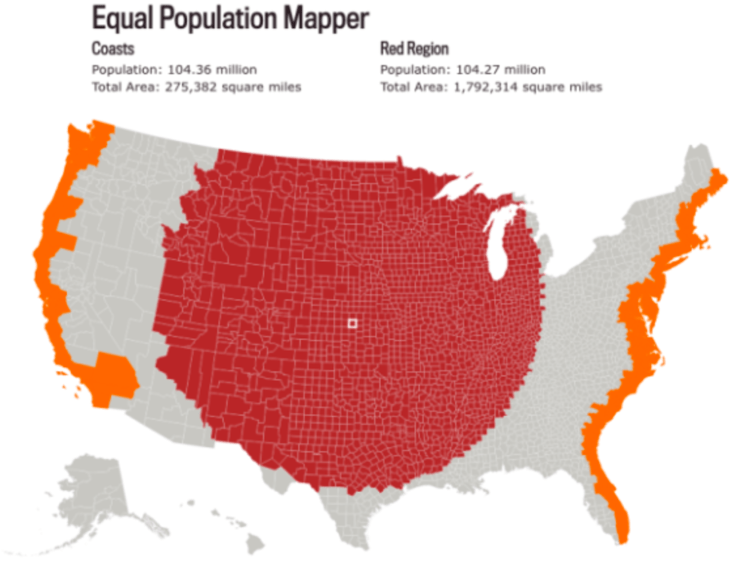
Equal population.png

Above is a map comparing the population all of the United States coastal counties (counties boarding the Atlantic or Pacific Oceans) to the same population of counties from mid-point of the US spreading out. The map above has equal population – 104 million to 104 million. The area (in square miles) of the middle counties is 6.5 times the area of the coastal counties.